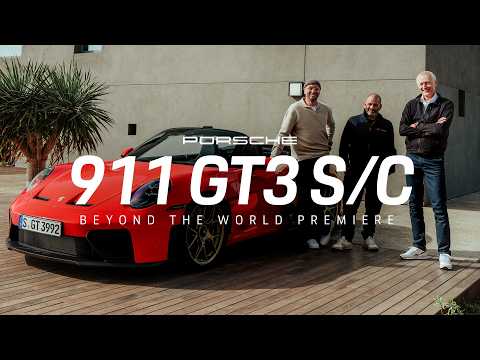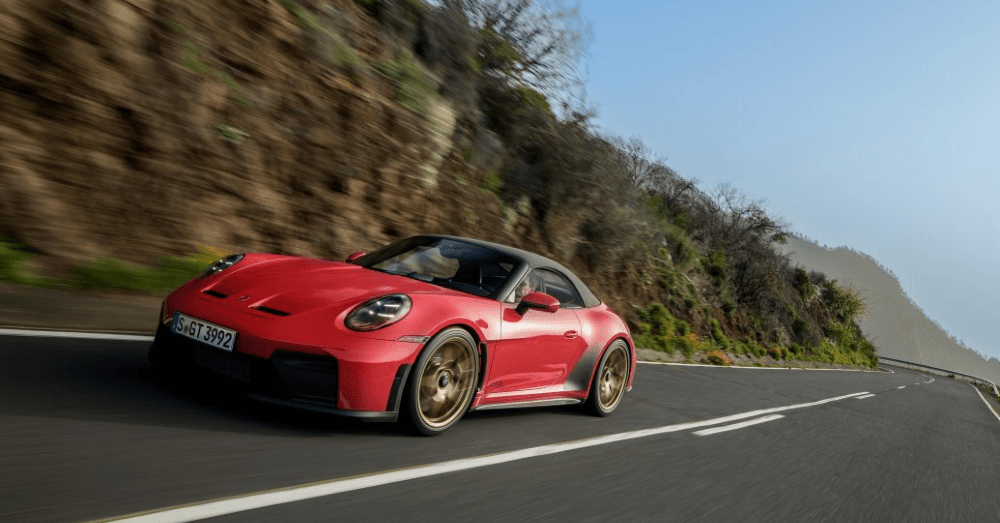
After 27 years of building the GT3 strictly as a fixed-roof coupe, Porsche has finally cut the top off its most beloved track weapon. The new 911 GT3 S/C, short for Sport Cabriolet, brings the high-revving flat-six experience to open-air drivers, and the German marque is making it manual-only.
- First open-top 911 GT3 ever, with a fully automated fabric roof that operates in about 12 seconds
- Naturally aspirated 4.0-liter flat-six making 502 hp, paired exclusively with a six-speed manual
- U.S. pricing starts at $273,000, with deliveries set to begin in fall 2026
A 27-Year Tradition Comes Down
Since its debut in 1999 as part of the 996 series, the GT3 has been available exclusively as a hard-top coupe. That changes with the S/C, which stands for Sport Cabriolet (the car is unrelated to the old 911 SC, or Super Carrera). Porsche GT boss Andreas Preuninger has been pushing for an open-top GT3 since the 997 generation, and he finally got the green light when the right pieces fell into place.
The S/C arrives as a spiritual follow-up to the manual-only 911 Speedster, but with a key twist. The newcomer is the first GT3 variant to feature a fully automated roof. No more wrestling with a manually deployed top when the weather turns. Porsche says the ragtop is easily operated with a single touch, taking just 12 seconds to go up or down, provided you don’t exceed 31 miles per hour.
Engine, Gearbox, and the Numbers That Matter
Under the rear deck sits the same screamer found in the regular GT3. The Porsche 911 GT3 S/C is powered by the same naturally aspirated 4.0-liter boxer engine found in the standard and Touring versions. It pumps out 502 hp and 331 ft lbs of torque, all of which is routed to the rear wheels via a six-speed manual, and redlines at 9,000 rpm.
Performance is right where you’d expect. It reaches 60 mph in 3.7 seconds, or 62 mph (100 km/h) in 3.9 seconds. Flat out, the latest 911 variant tops out at 194 mph (313 km/h). Going manual-only wasn’t just about purist ideology either. The manual is a whopping 28 kg lighter than the dual-clutch option, which was important in nudging the S/C into the same homologation process as the GT3. Any heavier and it would have needed to be reassessed in a higher weight class.
Lightweight Tricks and Borrowed Hardware
To offset the inevitable weight gain that comes with a folding roof, Porsche raided the parts bin from its other GT cars. The S/C borrows several components from the 911 S/T, including a carbon-fiber-reinforced hood, fenders, and doors. These modifications, along with ceramic-composite brakes and staggered magnesium wheels (20 inches up front, 21 inches in the back), mean the S/C tips the scales at 3,322 pounds.
That puts it about 66 pounds heavier than the old 991 Speedster, which is impressive given the added complexity of the powered roof. This is the first 911 convertible to use a double-wishbone suspension at the front axle. The chassis has been tuned to echo the 911 GT3 coupe with the Touring Package. Porsche also worked magnesium into the roof structure itself to keep mass low.
A Strict Two-Seater With Real Theater
Step inside and you’ll notice something unusual for a 911 convertible. There’s only room for a single passenger, as the rear seats have been removed, making the GT3 S/C the only 911 convertible sold strictly as a two-seater. The space behind the front buckets becomes a cargo area, optionally fitted with a storage box.
The model also features a powered wind deflector that deploys in just two seconds. Porsche is offering an optional Street Style package developed by Style Porsche and Exclusive Manufaktur, adding contrasting graphics, woven leather seat centers, and pyro red accents throughout the cabin. There’s also a dark gear lever topped with an open-pore walnut shift knob.
Pricing, Production, and How to Get One
Good news for enthusiasts who missed out on the 1,948-unit Speedster run. While the Speedster was capped at 1,948 units as a tribute to the year Porsche began production, the new GT3 S/C is not a limited-run model. Porsche won’t say how many it’ll build, but the order books are open.
The price of admission isn’t gentle. The GT3 S/C starts at $273,000, with U.S. deliveries kicking off in fall 2026 as a 2027 model. That’s roughly $40,000 more than the GT3 coupe, a premium that buys you sky overhead, the howl of an unfiltered flat-six, and the satisfaction of rowing your own gears.
Why This Convertible Actually Matters
For decades, the GT3 nameplate has stood for one thing. A road-legal track car with a roof bolted on for rigidity. The S/C tosses out that rulebook without watering down what makes the recipe work. Same engine, same redline, same manual gearbox, same razor-sharp front end. You just get to hear it all without a layer of metal between you and the air. For drivers who’ve been waiting for an open-top GT3 since the 997 days, it’s been a long time coming.